
The stats are undeniable: in motorsport and powersports retail, mobile devices generate the vast majority of overall website traffic. When riders are standing in their garage, oil on their hands, validating a broken component, they aren't opening a laptop. They have their smartphones out.
Unfortunately, this is where the customer journey typically crashes. Many e-commerce sites present OEM catalogs as complex, massive HTML tables, microscopic PDF lookups, or unoptimized desktop exploded diagrams that require aggressive pinch-and-zooming.
The Checkout Drop-Off
Analytics show that conversion rates on parts finder pages drop significantly when a user switches from desktop to mobile. This drop-off is purely a visual friction issue—customers cannot easily tap a part hotspot on a small screen.
The 3 Major Failures of Traditional Mobile Parts Finders
1. "Pinch-and-Zoom" Diagram Hell
Exploded schematic diagrams (microfiche) are high-density vectors designed for large monitors. On a mobile viewport, the numerical hotspots (e.g. indicating a washers, cylinder bolts, or o-rings) become sub-pixel elements. When customers attempt to tap number 14, their thumb triggers numbers 13, 15, and 17. The resulting frustration leads to abandoned carts.
2. Endless Desktop Data Tables
Once a customer zooms into a diagram, they have to scroll down to select their part from a huge table showing part numbers, descriptions, prices, and quantities. This tabular data was built for desktop. On mobile, columns squish, text wraps illegibly, and horizontal scrollbars force customers to scroll back and forth just to match a line item.
3. Lack of Context and Backtracking
If a mobile shopper zooms in, adds a screw, and wants to check if it fits their chassis, navigating backwards takes multiple button presses. Because standard browser memory resets scroll position on page refreshes, they lose their model coordinates and have to filter through KTM > Enduro all over again.
How to Fix Mobile Parts Search
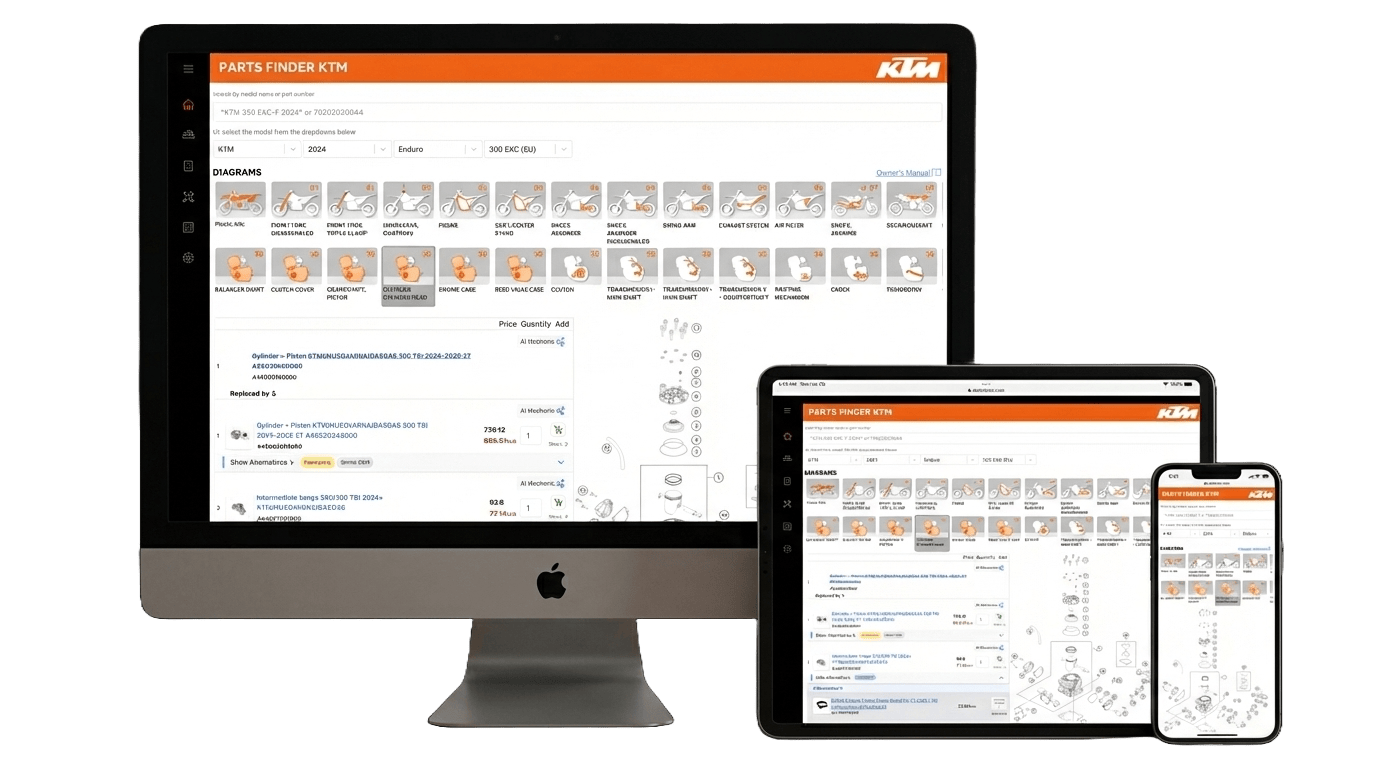
Relating the mobile parts dilemma requires replacing static diagrams and spreadsheets with **responsive vector layers** and mobile-centric layouts. Here is how Parts Finder Software architectures solve the mobile flow:
1. Gestures-Optimized Interactive Hotspots
Instead of standard desktop image maps, modern mobile parts finders run on responsive HTML5 Canvas or SVG overlays. Hotspots auto-scale, and tapping a part number triggers a clean popover with clear "Add to Cart" and "Compatibility" details, preventing incorrect taps.
2. Split-Screen Viewports
Rather than separating the exploded fiche diagram from the product price list, the viewport divides dynamically. The top 40% displays a swipeable zoomable vector diagram, and the bottom 60% contains a highly readable vertical list with quick-add actions, maintaining absolute visual reference.
3. Saved Garage Profiles
By storing customer selection details locally via browser storage (`localStorage` profiles), returning shoppers are welcomed by their specific bike. They skip selection screens and land directly on relevant diagrams.
The Business Benefit: Conversions & Service Efficiency
Upgrading your catalog to a responsive system does more than optimize e-commerce. It directly impacts your service counter:
- On-the-Floor Lookups: Workshop mechanics and parts desk staff can look up compatibility on tablets and phones right next to the bike, keeping workflows continuous.
- Increased Mobile Attach-Rate: When checkout is easy, impulse buying rises. Recommending related PowerParts or aftermarket gaskets directly inside the mobile overlay generates additional margin.
- Friction-free Brand Sync: Fast catalog filtering creates an experienced, modern brand feel that separates your dealership from legacy competitors.
Optimize Your Dealership
Traditional, clunky desktop layouts cost dealerships sales every day. Delivering a mobile parts experience that is as fluid on a smartphone as it is on a desktop service desk is a necessity. Upgrade your site with Parts Finder Software, and capture the segment of customers currently struggling to buy on their phones.