
Most Shopify fitment apps were built for the automotive aftermarket, where a clean year/make/model (YMM) grid and a fitment spreadsheet cover the job. Powersports OEM parts are messier: exploded diagrams, multi-year assemblies, and constant supersessions. Understanding which approach matches your catalog saves you from installing something that fights your data.
Approach 1: Year/Make/Model dropdown apps
The classic aftermarket pattern. A shopper selects year, make, and model, and the store filters to fitting products. Apps in this space (the PartsPal / Convermax style) are mature and well-suited to aftermarket catalogs.
- Strengths: Familiar UX, good for aftermarket accessories, works across many verticals.
- Weaknesses: You must supply and maintain the fitment spreadsheet. No exploded diagrams, no OEM catalog, no supersession handling. For OEM parts, building and maintaining that fitment data by hand is the real cost.
Approach 2: Generic fitment/compatibility tables
Apps that let you attach a compatibility table to each product. More flexible than a fixed YMM dropdown, but still fundamentally "you bring the data."
- Strengths: Flexible schema, cheap, works on any store.
- Weaknesses: Manual data entry at OEM scale is impractical — a single dealer catalog can run to tens of thousands of parts across many models and years. No diagrams, no supersession resolution, no price/stock sync.
Approach 3: Brand-deep OEM parts finder widgets
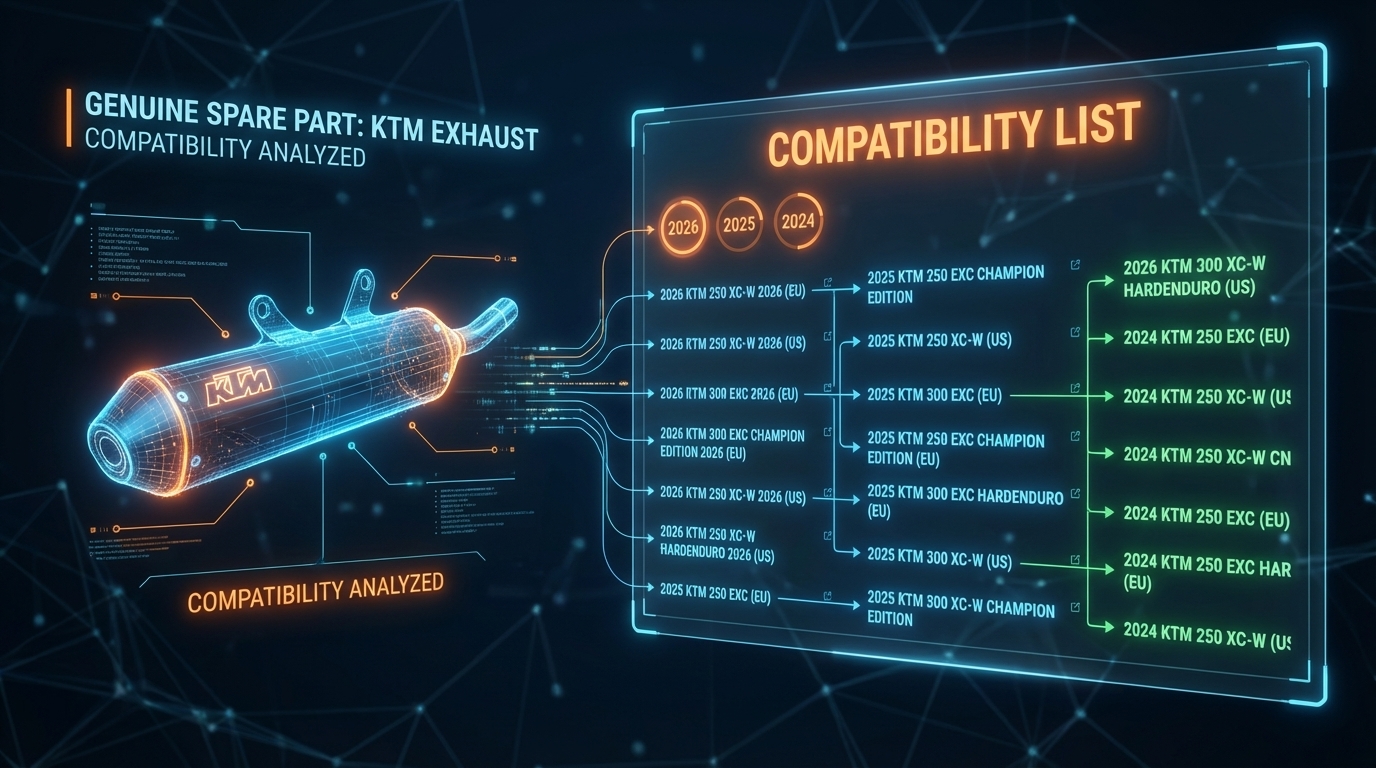
Instead of a generic fitment layer you populate yourself, this approach ships the OEM catalog data for specific brands: exploded fiche diagrams, part-to-model fitment, supersession chains, and price/stock sync, rendered as widgets on your store. This is the category Parts Finder Software is in.
- Strengths: No fitment spreadsheet to maintain, real exploded diagrams, supersession-aware, mobile-native, with aftermarket cross-sell. Purpose-built for KTM / Husqvarna / GasGas / Beta and similar dealers.
- Weaknesses: Focused on powersports OEM brands rather than every vertical — by design.
| Feature | YMM app | Generic table | OEM widget |
|---|---|---|---|
| You supply fitment data | Yes | Yes | No — included |
| Exploded fiche diagrams | No | No | Yes |
| Supersession handling | No | No | Yes |
| Price / stock sync | No | No | Yes |
| Best catalog fit | Aftermarket | Small catalogs | OEM powersports |
Which should a powersports dealer pick?
If you sell mostly generic aftermarket accessories, a YMM app is fine. If you sell OEM parts for a handful of brands at real catalog scale, a generic fitment app becomes a data-entry treadmill — the OEM widget approach removes that work entirely because the catalog, diagrams, and supersessions come with it.
For the wider tooling landscape see the parts lookup software buyer's guide, and for the end-to-end approach read selling OEM powersports parts online.