
Most dealers already have the demand: riders search for exact components constantly, and they'd rather buy from an authorized dealer than a gray-market seller. What holds parts e-commerce back is almost never traffic — it's the data and UX problems unique to OEM parts. This guide walks through the six things that actually determine whether your online parts channel grows or stalls.
1. Get the catalog data right first
Everything else sits on top of your parts data. You need OEM catalogs modeled relationally: assemblies, diagrams, the parts on each diagram, and which models each part fits. A flat product list can't express that a single bolt appears on nine diagrams across four model years. If your data model is wrong, no amount of front-end polish saves you.
Do this: model brand → model → assembly/diagram → part, with fitment as a many-to-many relationship. Keep manufacturer SKUs as the join key. Our KTM/Husqvarna Shopify integration guide shows the schema.
2. Handle supersessions or lose fulfillable sales
OEM part numbers get replaced constantly. If your store treats an old number as a dead product, you lose the sale even when the replacement is in stock. Every historical number must be searchable and must resolve to the current orderable SKU.
Do this: ingest the supersession table and auto-resolve chains to the terminal SKU. Full detail in part supersessions explained.
3. Verify fitment on the product page
The number-one reason online parts orders fail is fitment guessing. A shopper who can't confirm "does this fit my 2024 350 EXC-F?" either doesn't buy or buys wrong. Put a live compatibility check directly on the product page so the answer is unambiguous before checkout.
Do this: add a compatibility widget that reads the SKU and shows fitment status inline. This is the single biggest lever on reducing returns.
4. Keep price and inventory in sync
Parts pricing and stock change often, and they usually live in your DMS or distributor feeds, not in your storefront. Manual updates guarantee stale prices and oversells. Automate the sync so the storefront always reflects reality.
Do this: connect distributor price/inventory feeds and your DMS to the storefront on a schedule. See syncing Lightspeed DMS inventory with Shopify.
5. Make it work on mobile
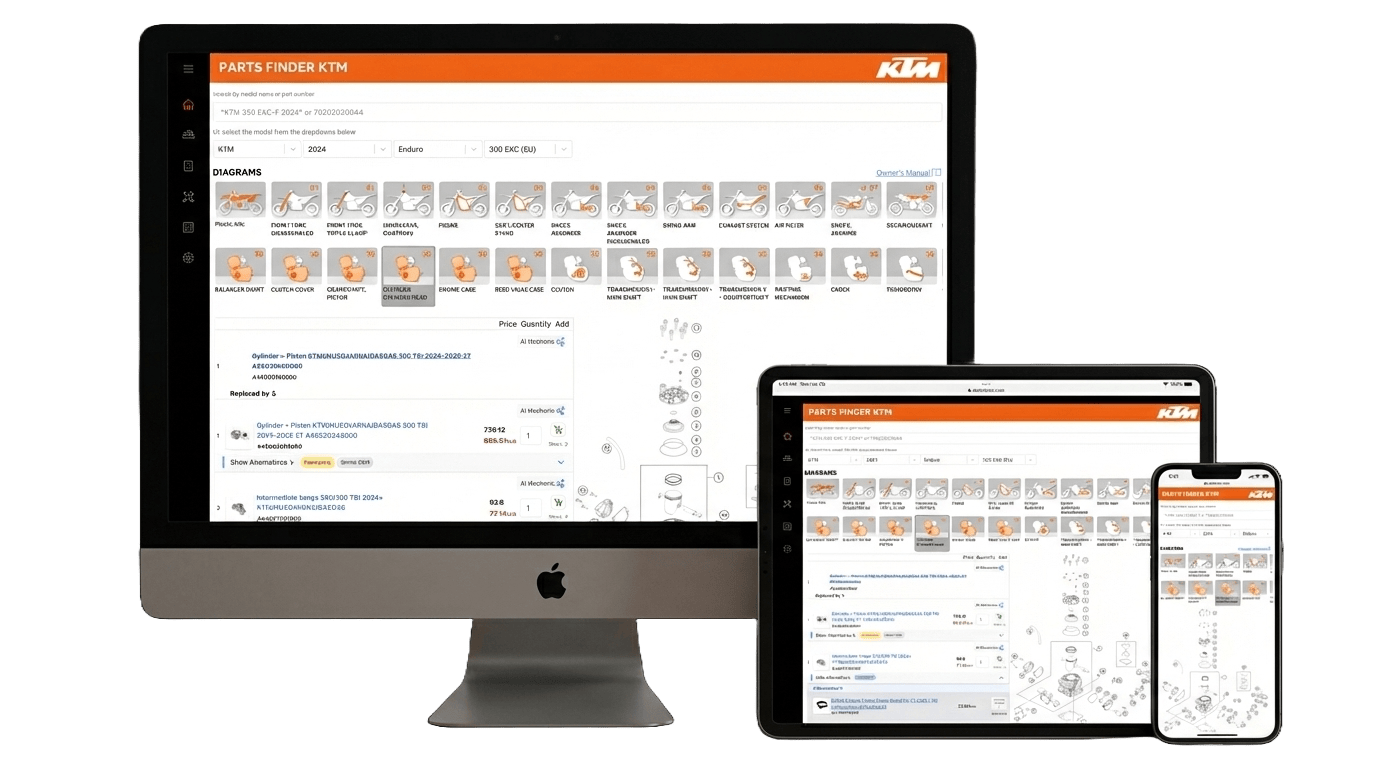
Riders look up parts in garages, on phones, with dirty hands. Traditional desktop microfiche is unusable there. Exploded diagrams need pinch-zoom, tap-to-select hotspots, and a parts list that doesn't require a mouse. If your fiche only works on desktop, you're losing your largest traffic segment.
Do this: use mobile-native fiche rendering. Background in why traditional catalogs fail on mobile.
6. Cross-sell the right upgrades
Once fitment is solved, cross-sell becomes safe and valuable. A customer buying an OEM part is a strong candidate for the matching aftermarket upgrade or official PowerParts accessory — but only recommendations that actually fit their bike. Fitment-aware cross-sell lifts average order value without creating new returns.
The compounding effect
These six layers reinforce each other: clean data enables fitment, fitment enables safe cross-sell, sync keeps it all honest. The dealer in our ASM Shop case study put them together and grew parts e-commerce sales 15x while cutting returns from 12% to 1.75%.
Build vs. buy
You can build all of this in-house — relational catalog, supersession pipeline, fitment engine, mobile fiche, sync jobs — but it's a serious, ongoing engineering commitment against constantly changing OEM data. The alternative is to embed a purpose-built layer into your existing storefront.
Parts Finder Software packages all six layers as widgets for authorized KTM, Husqvarna, GasGas, Beta and similar dealers, running on your existing Shopify or custom store. If you're comparing approaches, start with the parts lookup software buyer's guide.