
Point-of-sale systems like Lightspeed hold the authoritative view of a dealership's parts: cost, retail price, on-hand quantity, and location. Shopify holds the storefront. The moment a part sells at the counter, or a distributor price file updates, the storefront is out of date — unless something keeps them aligned automatically.
What actually needs to sync
- Price: retail price per SKU, including any market- or currency-specific pricing.
- Inventory: on-hand quantity, ideally reflecting counter sales in near-real time.
- Availability status: orderable vs. discontinued (which ties into supersessions).
- New parts: SKUs added in the DMS or distributor catalog that should appear online.
The matching problem
Sync lives or dies on the join key. The manufacturer SKU is the only identifier reliably shared between your DMS, distributor feeds, and storefront. Use it as the canonical key everywhere. Where a DMS uses an internal item ID, keep a mapping back to the manufacturer SKU so records reconcile cleanly.
Watch the supersession trap
A distributor feed may quote stock under a current SKU while your storefront still lists an old superseded number. If you don't resolve supersession chains first, sync will report "0 in stock" for a part that's actually available under its new number.
Sync architecture patterns
- Scheduled pull: a job fetches DMS/distributor price and stock feeds on an interval (e.g. every few minutes to hourly) and pushes updates to Shopify via the API. Simple, robust, good enough for most dealers.
- Event-driven: the DMS emits a change event on each counter sale, updating the storefront near-instantly. Lower oversell risk, more integration work.
- Buffered stock: hold a small safety buffer so simultaneous counter and online sales don't oversell the last unit.
Multi-provider reality
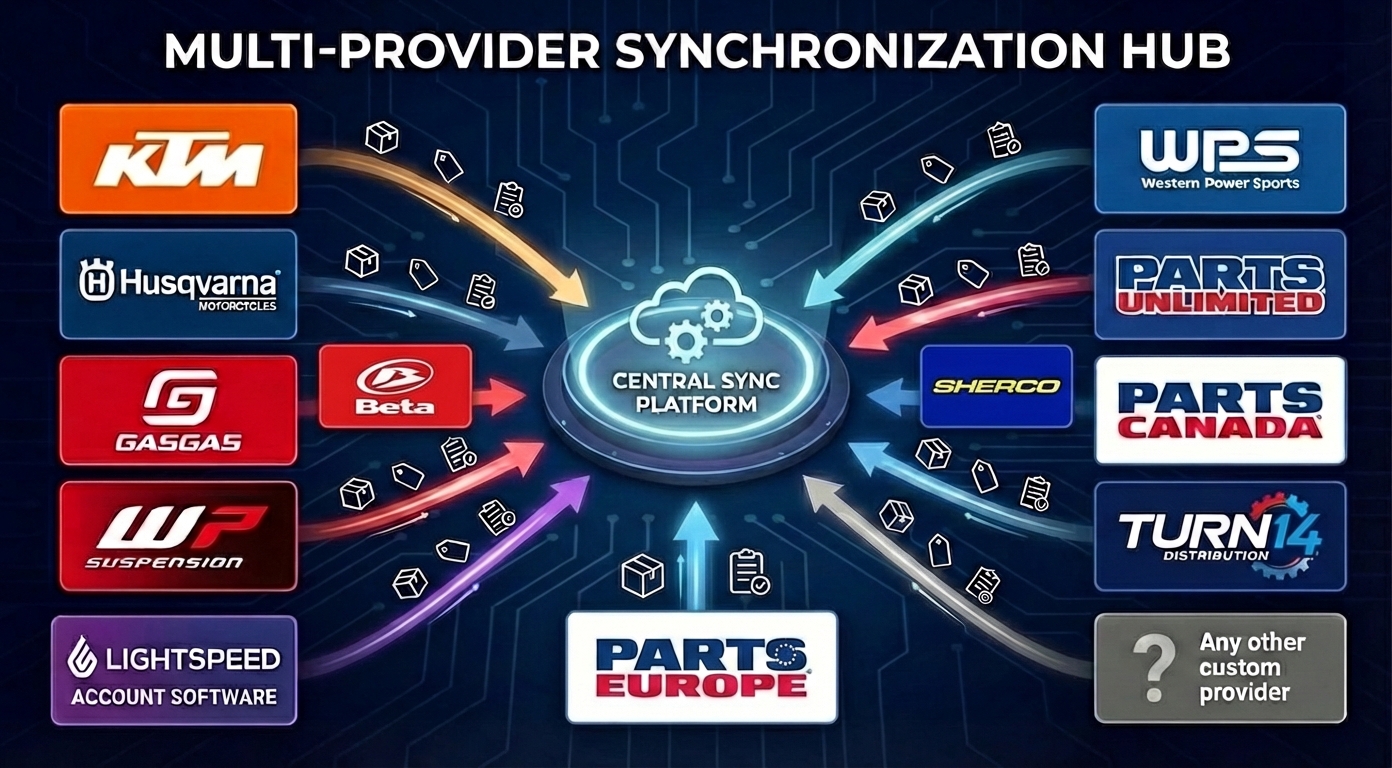
Most dealers don't have a single source of stock. You might carry local inventory in the DMS plus dropship availability from one or more distributors. Good sync merges these: show the best available price and combined stock, and prefer local inventory for margin and speed. This "multi-provider sync" is exactly the layer that keeps a storefront honest across DMS and distributor feeds at once.
How Parts Finder Software handles it
Parts Finder Software includes multi-provider price and inventory sync as part of the platform. It matches on manufacturer SKU, resolves supersessions before reconciling stock, merges DMS and distributor availability, and keeps the storefront widgets showing live, accurate pricing. It's one of the six layers described in the guide to selling OEM parts online, and the data plumbing is detailed in integrating parts databases with Shopify.